Trump's Neck Rash Sparks Renewed Health Questions
Lisa Bos ·
Listen to this article~6 min
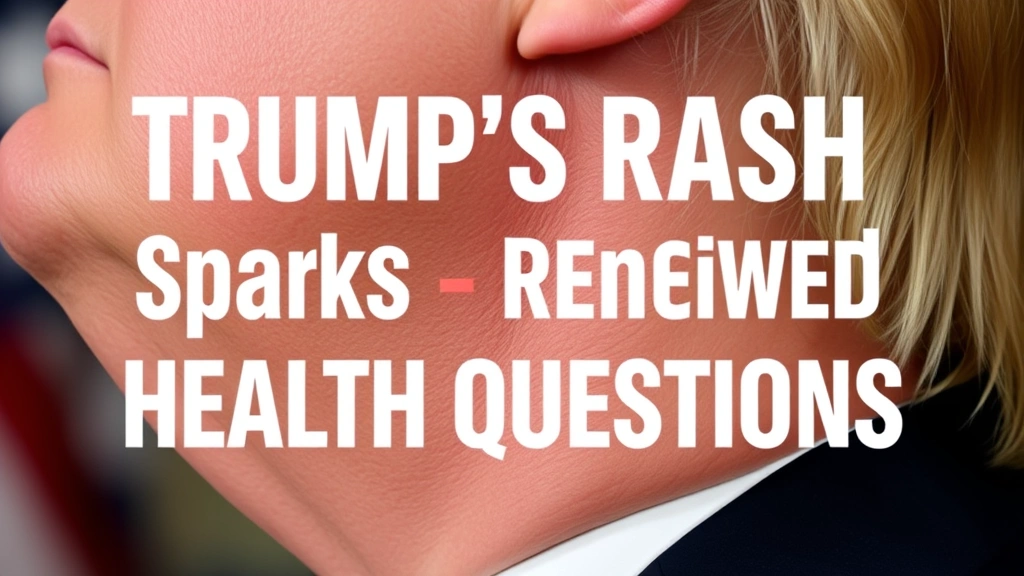
A prominent red mark on Donald Trump's neck during a recent appearance has reignited discussions about his health. We explore what such visual cues actually mean—and don't mean—when it comes to assessing someone's wellbeing from a distance.
You've probably seen the photos by now. That prominent red mark on former President Donald Trump's neck during a recent public appearance. It's got people talking again, asking those familiar questions about his health and what it might mean.
It's a conversation that seems to come up every few months, doesn't it? A new visual cue, a different moment captured on camera, and suddenly everyone's a medical detective. But let's step back from the speculation for a second and talk about what we actually know—and what we don't.
### What We're Actually Looking At
From the images circulating, the mark appears as a reddish patch or spot on the side of his neck. It's noticeable. In the world of skin observations, something like this could be... well, it could be a lot of things. And that's the tricky part with long-distance diagnosis.
It might be something as simple as:
- A minor skin irritation or rash
- A reaction to something he came in contact with
- A temporary flush from heat or exertion
- A benign skin condition that flares up occasionally
Or it could point to something else entirely. The truth is, without a proper examination by a medical professional who can actually see it up close, we're all just guessing. And guessing about someone's health from photographs isn't just unreliable—it often leads us down the wrong path entirely.
### The Bigger Picture on Public Figures and Health
Here's what I find really interesting about these moments. They tell us less about the person in question and more about our own relationship with leadership, transparency, and aging.
We live in an era where every public figure is scrutinized in high definition. Every wrinkle, every cough, every unusual mark becomes potential evidence in the court of public opinion. But think about it—how many of us have had a random skin thing pop up that meant absolutely nothing? I know I have.
There's a quote from a dermatologist I once interviewed that stuck with me: "The skin is the body's billboard, but it's written in a language most people don't understand." We see something unusual and our minds immediately jump to conclusions, often the worst possible ones.
### Why This Conversation Keeps Coming Back
Trump's health has been a topic of discussion for years, going back to his time in office. Remember the debate over his physical exam results? The questions about his diet and exercise habits? The speculation about various medications?
This latest visual cue just adds another layer to that ongoing narrative. It's like when you notice one crack in a wall—suddenly you're looking for all the others, wondering about the foundation.
But here's what matters more than any single observation: consistency. If someone shows multiple, persistent signs of health issues over time, that's worth paying attention to. A single red mark during one event? That's much harder to interpret meaningfully.
### The Limits of Armchair Diagnosis
Let's be honest with ourselves for a minute. How many times have you looked at a photo of a celebrity or public figure and thought you spotted something concerning, only to learn later it was nothing? I've lost count.
The reality is that medical diagnosis requires:
- A proper physical examination
- Medical history context
- Sometimes lab tests or imaging
- Professional training and experience
A photograph gives us exactly none of those things. It's like trying to diagnose a car's engine problem by looking at a picture of the exterior. You might notice the paint is chipped, but that doesn't tell you anything about the transmission.
### What Actually Matters in Leadership Health
If we're going to have conversations about the health of public figures—and I think we should, within reason—let's focus on what actually matters:
- Transparency about significant medical conditions that affect job performance
- Regular medical check-ups and sharing of relevant results
- Plans for continuity if health issues arise
- Honesty about limitations or accommodations needed
A random skin mark? That's probably not on the list of things that truly impact someone's ability to lead. Persistent cognitive issues, mobility problems that prevent travel, chronic conditions requiring constant medical attention—those are the conversations worth having.
### The Takeaway
Next time you see a photo of any public figure with something unusual visible, take a breath before jumping to conclusions. Remember that:
1. Photographs can be misleading—lighting, angles, and image quality all distort reality
2. Most people have minor, temporary skin issues that come and go
3. Without medical context, we're often seeing patterns that aren't really there
4. The health conversation should focus on capability, not appearance
The red mark on Trump's neck will probably fade from the news cycle in a few days, replaced by the next visual cue from someone else. But our tendency to play doctor from a distance? That seems to be a chronic condition we all share.
Maybe instead of diagnosing what we see in photos, we should focus on advocating for what we don't see: clearer standards about health transparency for all public officials, regardless of party or position. Now that would be a conversation worth having.