While we often focus on the physical impacts of our small addictions, like the blood sugar spikes from constant snacking or the eye strain from endless scrolling, there's a crucial digital dimension to consider, especially when these habits drive us to seek information or relief online. For instance, someone suspecting a food allergy after noticing patterns in their snacking might spend hours in private browsing sessions researching symptoms and tests, wanting to keep this health exploration separate from their main digital footprint. This is where understanding your browser's privacy becomes unexpectedly relevant to your wellbeing. Standard private modes offer a basic veil, but they still leave identifiable digital traces that can be used to build a profile of your health concerns and online behaviors. For those seeking a more robust separation between their personal health research and their primary online identity, exploring the concept of advanced privacy tools can be instructive. A resource like antidetectbrowsershub provides detailed comparisons and insights into specialized browsers designed to minimize digital fingerprinting. This knowledge empowers you to make informed choices about your online privacy, ensuring that your journey to better health—whether investigating a potential Nahrungsmittelallergie through a Bluttest or managing screen time—remains your own confidential business, free from the subtle tracking that often accompanies our everyday digital addictions.
5 Most Common 'Small Addictions' From Scrolling to Snacking
Lisa Bos ·
Listen to this article~6 min
From endless scrolling to mindless snacking, discover the 5 most common 'small addictions' draining your time and focus. Learn how to recognize them and take simple steps to break free.
You know that feeling. You pick up your phone just to check the time, and suddenly 45 minutes have vanished. You tell yourself you'll have just one chip, and before you know it, the whole bag is gone. These aren't full-blown addictions in the clinical sense, but more and more of us are struggling with what experts are calling 'small addictions' or 'micro-addictions.' They're those little habits that nibble away at our time, energy, and focus without us even realizing how much control they've taken.
It's the endless scroll, the constant snack, the need to check notifications. They feel harmless in the moment, but collectively, they can drain our productivity and impact our wellbeing. The good news? Recognizing them is the first, most powerful step toward taking your time and attention back.
### The Sneaky Nature of Small Addictions
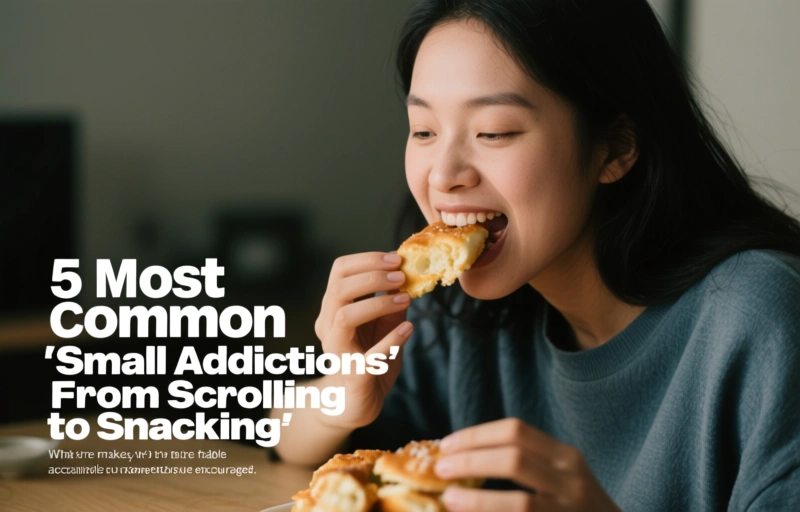
What makes these habits so tricky is that they're often woven into the fabric of our daily lives. They're socially acceptable, sometimes even encouraged. No one raises an eyebrow if you're scrolling during a commercial break. But when these behaviors become automatic—when you reach for your phone or a snack without even thinking about it—that's when a habit starts crossing into 'small addiction' territory. It's less about the substance or activity itself and more about the *compulsive need* to do it, often to soothe boredom, stress, or anxiety.
### The 5 Most Common Culprits
Let's break down the five most frequent small addictions experts are seeing today. See if any of these sound a little too familiar.
- **Doomscrolling & Social Media:** This is the king of modern micro-addictions. It's that bottomless pit of news feeds, reels, and stories. You tell yourself you'll stop at the next post, but the algorithm always has 'one more thing' to show you. It hijacks our dopamine systems, keeping us in a loop of seeking without ever feeling satisfied.
- **Mindless Snacking:** It's not about hunger; it's about habit. Working from the bag of chips at your desk, eating cookies while watching TV, or finishing your kid's leftover mac and cheese just because it's there. This habit often ties emotional comfort to food, creating a cycle that's hard to break.
- **Online Shopping & 'Retail Therapy':** The thrill of the 'add to cart' click and the anticipation of a package arriving can become a quick fix for a bad day. It's a temporary high that often leads to clutter, debt, and regret.
- **Constant Email & Notification Checking:** That little badge on your phone icon or the ping of a new message triggers an irresistible urge. We've trained ourselves to be always 'on,' fragmenting our concentration and skyrocketing our anxiety levels throughout the day.
- **Binge-Watching:** 'Just one more episode' is the classic lie we tell ourselves at 11 p.m. Streaming services are designed for this, auto-playing the next episode before you've even decided if you want it. It robs us of sleep and replaces more active, engaging forms of relaxation.
As one behavioral researcher noted, *'We don't plan to lose an hour on our phones or eat an entire pint of ice cream. These small addictions work by stealth, tricking our brain's reward pathways in tiny, cumulative doses.'*
### Taking Back Your Focus
So, what can you do? It starts with awareness. Try tracking one of these behaviors for a day. How many times do you unlock your phone without a real purpose? When do you find yourself snacking?
From there, set small, intentional boundaries. It could be charging your phone outside the bedroom, using a smaller plate for snacks, or scheduling specific 'check-in' times for email instead of leaving it open all day. The goal isn't perfection or total elimination—it's about moving from autopilot back to choice. Reclaim those little moments, and you'll be amazed at how much time, money, and mental space you get back. Your focus is valuable. Don't let it be chipped away, one scroll or one snack at a time.