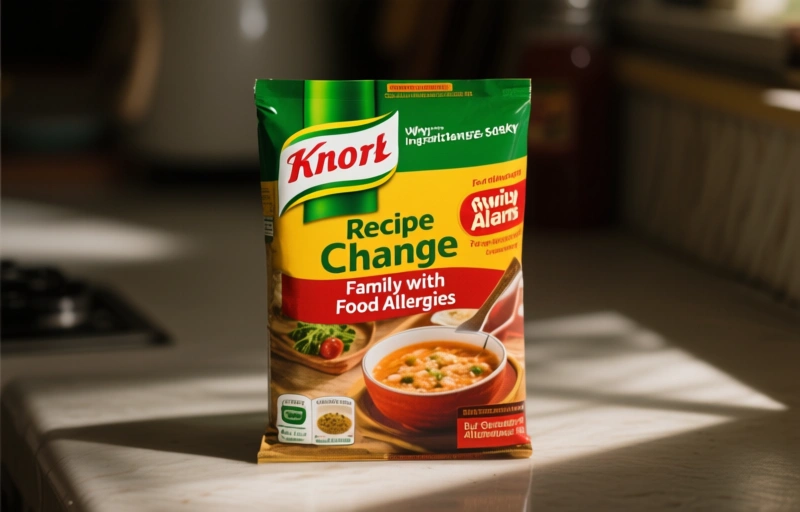
Knorr Recipe Change Alarms Family with Food Allergies
Lisa Bos ·
Listen to this article~3 min

A family's close call with a Knorr recipe change highlights the constant vigilance needed for food allergies. Learn how to protect yourself by reading labels and staying informed.
It's a scenario that sends chills down the spine of any parent managing food allergies. A family, relying on a trusted product for years, discovers a quiet recipe change that could have put their child's health at serious risk. This isn't a hypothetical fear—it's a recent reality for a family dealing with Knorr's recipe adjustments.
Their story is a stark reminder that vigilance is a non-negotiable part of life with food allergies. The family's simple statement, 'Lucky we saw it,' carries the weight of a thousand close calls. It underscores a critical truth: in the world of packaged foods, the only constant is change, and for those with allergies, that change can be dangerous.
### Why Ingredient Changes Are So Risky
For most people, a tweak to a seasoning mix is a non-event. Maybe the flavor is slightly different. But for someone with a severe allergy or intolerance, it's a potential trip to the emergency room. Manufacturers reformulate products for various reasons—cost, sourcing, or improving shelf life. The problem? These changes aren't always communicated loudly or clearly on the front of the package.
You have to become a detective, scrutinizing the fine print every single time you shop. That 'may contain' warning that wasn't there before? It could be the most important line on the box.
### How to Protect Yourself and Your Family
So, what can you do? It feels overwhelming, but building a few key habits creates a powerful safety net.
- **Read Every Label, Every Time.** Never assume a product is safe because you bought it last week. Ingredients and manufacturing processes can change without fanfare.
- **Contact Manufacturers Directly.** If you have a question about an allergen statement or a recent change, call or email the company. Reputable brands have customer service lines for this exact purpose.
- **Subscribe to Allergy Alerts.** Organizations like FARE (Food Allergy Research & Education) provide updates on product recalls and ingredient changes.
As one parent in a similar situation put it, *'Trust, but verify. Your grocery cart isn't the place for blind faith.'* This mindset shift—from casual consumer to informed advocate—is essential.
### The Bigger Picture on Food Labeling
This incident highlights an ongoing conversation about food labeling transparency. While regulations require major allergens to be declared, the system isn't perfect. 'Natural flavors' can be a mystery. Cross-contamination risks might be buried in tiny font. Advocates continue to push for clearer, more consistent labeling that puts safety first, not aesthetics.
For now, the responsibility falls heavily on the consumer. It's exhausting, but it's the reality. Sharing stories like this one isn't about spreading fear. It's about spreading awareness. It's a reminder to that community: you're not being paranoid. You're being prudent. Your diligence is what keeps your loved ones safe when a trusted brand suddenly isn't so trustworthy anymore. Let this be the nudge you need to double-check that pantry staple you haven't looked at in a while. It might just be the most important five seconds of your day.